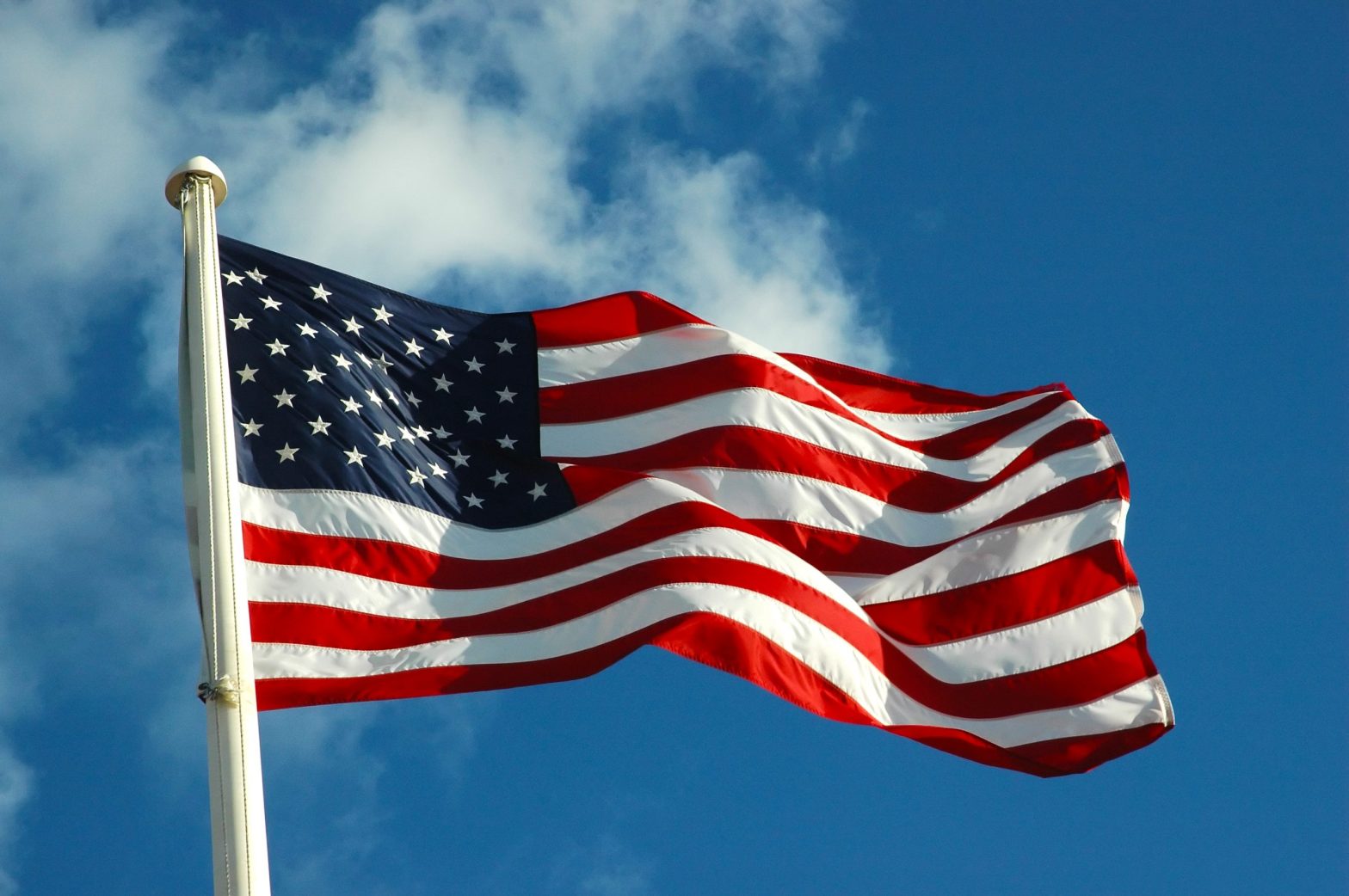
Flag Day is celebrated on June 14 of every year. What is Flag Day all about? Who really designed the first flag, and what do the red, white, and blue colors symbolize? Let’s dive into some history about what we fondly call the “Stars and Stripes”!
What is Flag Day?
Flag Day is a celebration of the American flag that occurs each year on the anniversary of the flag’s official adoption, June 14.
When the American Revolution broke out in 1775, the colonists weren’t fighting united under a single flag. Instead, most regiments participating in the war for independence against the British fought under their own flags. Colonial troops fought under many different flags with various symbols—rattlesnakes, pine trees, and eagles—and slogans—”Don’t Tread on Me,” “Liberty or Death,” and “Conquer or Die,” to name a few.

Flag used by The Continental Navy 1776
In June 1775, the Second Continental Congress met in Philadelphia to create the Continental Army—a unified colonial fighting force—with the hopes of a more organized battle against its colonial oppressors. This led to the creation of what was, essentially, the first “American” flag, the Continental Colors, more commonly known as the Grand Union flag.
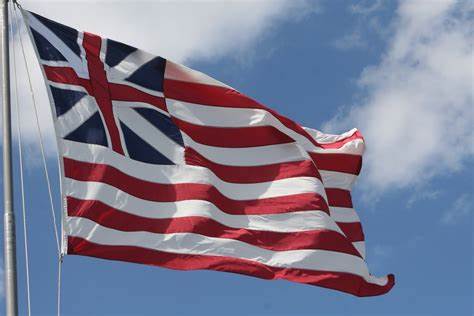
First unofficial US flag – The Grand Union Flag 1776
For some, this flag, which was comprised of 13 red and white alternating stripes and a Union Jack in the corner, was too similar to that of the British flag. George Washington soon realized that flying a flag that was even remotely close to the British flag was not a great confidence-builder for the revolutionary effort, so he turned his efforts towards creating a new symbol of freedom for the soon-to-be fledgling nation. Following the Declaration of Independence in July 1776, the adoption of an American flag became imperative. Previously, each colony or special interest had its own flag.
On June 14, 1777, the Second Continental Congress took a break from writing the Articles of Incorporation and passed the Flag Resolution of 1777 stating: “The flag of the United States shall be thirteen stripes, alternate red and white, with a union of thirteen stars of white on a blue field …” Official announcement of the new flag was not made until Sept. 3, 1777.
Who Made the First American Flag?
The origins of the Stars and Stripes, or Old Glory, have become part of American folklore. Although many people believe that Betsy Ross designed and sewed the first flag, there is no true proof of this. However, records do indicate that Betsy Ross most definitely made ensigns and pennants for the Philadelphia Navy during the war, and she certainly inspired the design of the first American flag. It was not until her grandson William Canby held an 1870 press conference to recount the story that the American public learned of her possible role. It has since been confirmed that Francis Hopkinson, a delegate from New Jersey who signed the Declaration of Independence, designed the American flag.
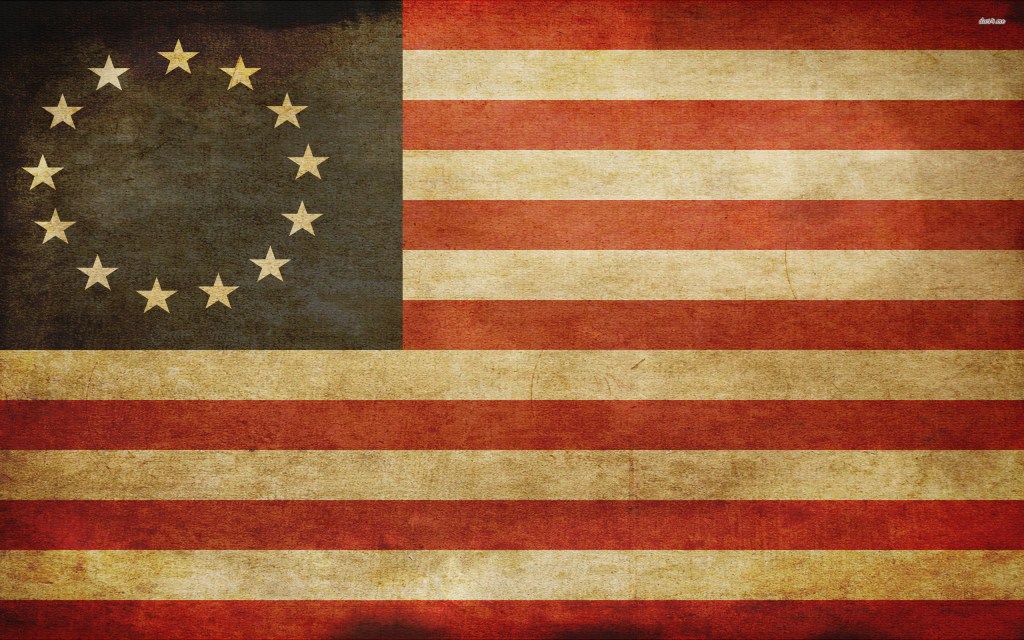
First official United States flag – the Betsy Ross Flag or “Stars and Stripes”
Based on colonial folklore, it has also been stated that the American flag was first flown in battle during the Revolutionary War at the Battle of Cooch’s Bridge in 1777.
What we do know is this:
- The original 1777 flag was designed to represent the 13 original colonies with 13 white stars on a blue field and 13 alternating red and white stripes.
- One of the first flag designs had the stars arranged in a circle, based on the idea that all colonies were equal.
- In 1818, after a few design changes, the United States Congress decided to retain the flag’s original 13 stripes and add new stars to reflect each new state that entered the union.
- Each time a state was added to the union, a star was added. Today, there are 50 stars, one for each state in the union, but the 13 stripes remain.
Interestingly, the current American flag was designed by a 17-year old high school student from Lancaster, Ohio, named Bob G. Heft! In the 1950s, when it seemed certain that Alaska would be admitted to the Union, designers had begun retooling the American flag to add a 49th star to the existing 48. Heft borrowed his mother’s sewing machine, disassembled his family’s 48-star flag and stitched on 50 stars in a proportional pattern. He handed in his creation to his history teacher for a class project, explaining that he expected Hawaii would soon achieve statehood as well. But, Bob’s history teacher gave him a “B-” for not knowing how many states the Union had! Unswayed, Heft sent the flag to his congressman, Walter Moeller, who presented it to President Dwight D. Eisenhower after both new states joined the Union in 1959. Eisenhower selected Heft’s design, and on July 4, 1960, the president and the high school student stood together as the 50-star flag was raised for the first time. Today, it’s Bob Heft’s 1958 design—showing 50 stars into a field that includes five rows of six stars and four rows of five stars—that is our 50-star American flag (and the history teacher changed his grade to an “A” but it may have been a little late for graduation!).
Facts About Flag Day and the American Flag
Flag Day was observed nationally for the first time on the 100th anniversary of the Stars and Stripes on June 14, 1877. Bernard Cigrand, a small-town Wisconsin teacher, originated the idea for an annual Flag Day, to be celebrated across the country every June 14, in 1885. That year, he led his school in the first formal observance of the holiday following the 100th anniversary. Cigrand, who later changed careers and practiced dentistry in Illinois, continued to promote his concept and advocate respect for the flag throughout his life. But our June 14 Flag Day wasn’t made official until May 30, 1916 when President Woodrow Wilson signed a presidential proclamation, almost 140 years after the Flag Resolution of 1777 establishing the United States flag.
Why is the American Flag red, white, and blue? The Continental Congress left no record as to why it chose these colors. However, in 1782, the Congress of the Articles of Confederation chose the colors for the Great Seal of the United States with these meanings:
- white for purity and innocence
- red for valor and hardiness
- blue for vigilance, perseverance, and justice
The American flag can be flown 24 hours a day in certain places. Out of respect, the flag is usually taken indoors at night but there are some places where flying the flag around the clock is permissible. These places include:
- The Betsy Ross House in Philadelphia
- The White House
- The U.S. Capitol
- The Iwo Jima Memorial to U.S. Marines in Arlington, Virginia
- The Revolutionary War battleground in Lexington, Massachusetts
- The site of George Washington’s winter encampment at Valley Forge, Pennsylvania
- Fort McHenry in Baltimore, Maryland
- The Jenny Wade House in Gettysburg, Pennsylvania (Jenny Wade was the only civilian killed in the Battle of Gettysburg, during the Civil War)
- The USS Arizona Memorial at Pearl Harbor
- All customs points of entry into the United States
- Any US Navy ship that is under way
- In truth, the flag may be flown at night anywhere that it may be flown during the day, provided that it is properly illuminated during the hours of darkness.
There have been 27 versions of the American Flag. And, the U.S. flag has been placed on the moon by an astronaut during six Apollo missions (11, 12, 14, 15, 16, and 17)!
Last, a flag expert is known as a vexillologist!
Flag Code of Conduct
Flag etiquette has long been established to ensure the flag is treated with dignity. In 1942, Congress created the U.S. Flag Code which provides guidelines for the display and care of the flag. You can get information about American Flag Etiquette here. Examples of proper flag etiquette:
Is it ever appropriate to fly the flag upside down? Yes, but only in an emergency. It means “Help Me! It’s an emergency! Call the police! I am in dire trouble and need immediate help!”
The practice of draping coffins in the American flag is not reserved for military veterans and government officials. On the contrary, any burial may incorporate this tradition.
Can the flag touch the ground? Despite the myths, the flag can touch the ground and still be washed and used. However, if the flag is torn or damaged beyond repair, the tradition is to burn it with dignity. Most U.S. localities offer this service at no fee.
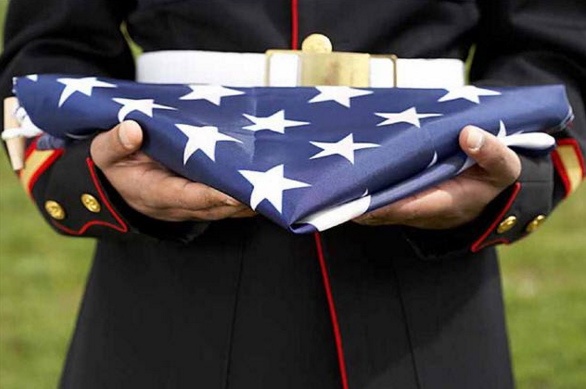
Why must Old Glory be folded in such a specific way? The U.S. flag is folded into a small triangle made of 13 folds. Each fold has special meaning and symbolism. For example, the first fold represents life, while the third honors the veteran who has departed and the fifth is a tribute to our country. You can check out the proper way to fold your flag here as demonstrated by two members of the Joint Base Andrews Honor Guard team.
Fly your flag proudly on Flag Day (and every other day, too)!
 Real Estate | Your@HomeTeam