
Renting can feel like the easier choice right now. There’s no big down payment. No dealing with surprise repairs. And no long-term commitment.
But then your rent goes up again. And again. And suddenly the thing that seemed flexible starts looking… expensive, especially considering you’re not building any equity. And once that happens, it’s easy to feel a little trapped in the cycle.
That’s because there’s so much chatter today about how buying a home isn’t affordable. But the truth is, the math may work out better than you’d expect based on what’s changed recently.
Buying Is More Affordable Than Renting in Many Areas
In a lot of places today, owning a home actually costs less each month than renting a 3-bedroom home. And recent data from ATTOM shows that’s true in nearly 58% of counties across the U.S. (see chart below).
And that’s after you factor in things like insurance and typical maintenance costs.
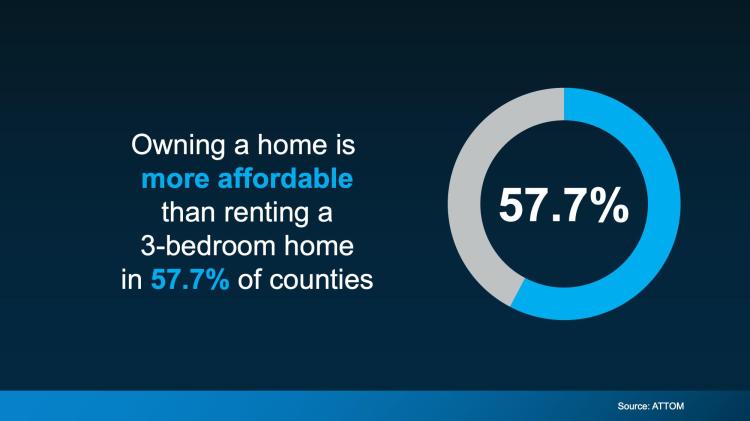
In other words, even though it may feel like a bit of a shock, the numbers show rent often stretches monthly budgets more than owning does. That’s thanks to slower home price growth, more homes for sale, and monthly mortgage payments starting to ease as rates come down.
Affordability Still Varies by Region
Now, even though nationally the balance has shifted, that doesn’t mean buying is more affordable in every market or for every renter.
While buying is more affordable than renting in nearly 58% of counties nationwide, that share looks different depending on your region (see graph below):
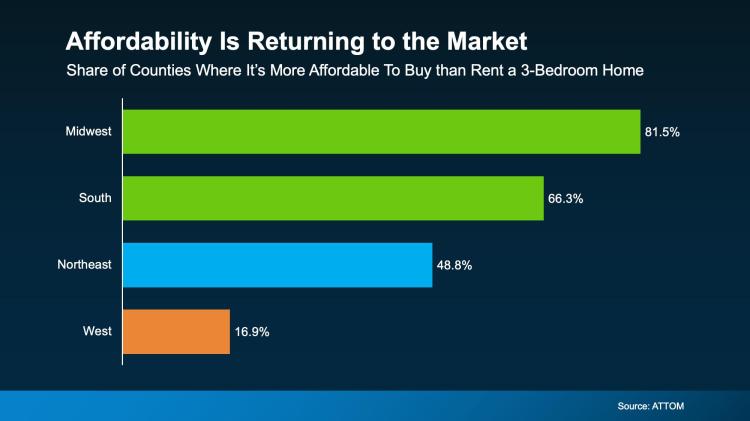
The biggest improvement is happening in the Midwest and South. But if you’re living in the West, things could still feel tight.
The takeaway? How affordable buying is really depends on where you live. And the only way to know how this plays out where you live is to look at the numbers locally.
So, What’s Still Holding Buyers Back?
Maybe you’re nodding along so far but thinking, “Okay, but I still can’t afford the upfront costs.” If that’s your reaction, you’re not the only one.
For many renters, the biggest hurdle isn’t the monthly payment alone. It’s the down payment, too.
But you’re not out of options. Here’s the part most people don’t hear enough about: there are thousands of down payment assistance programs available across the country, and many buyers qualify without realizing it.
And the average benefit? Roughly $18,000.
Want an example? If you are a first-time homebuyer and meet the requirements, one program we are familiar with features a $10,000 GRANT! As in – “Free Money!” This loan requires just a 3% down payment, does not require mortgage insurance to be paid (loans less than 20% down typically require this to the tune of $150-200/mo!) and you can “piggyback” other assistance programs with this program to further help with your down payment and closing costs. In addition, there are also some assistance programs for repeat home buyers, too.
This kind of assistance support can help cover much of your down payment and closing costs, which means you may not need to save nearly as much as you think to get started. The loan program above requires you have at least $500 of your own money to contribute; the rest can be assistance programs! And, yes, it can be done!
When you combine that with monthly payments that may work better than expected, especially as rates continue to ease and prices cool, buying may feel far more realistic than it looks at first glance.
Bottom Line
The point isn’t that everyone should rush out and buy a home tomorrow.
It’s that renting isn’t always the more affordable option people assume it is – and buying may be more realistic than it feels once you look at the full picture.
If you’re renting and feeling stuck in the “someday” loop, it might be worth a simple conversation. Want to learn more about these assistance programs? Get in touch with so you can see what’s possible and whether buying a home makes sense for you.
 Real Estate | Your@HomeTeam